

Early Engineers Express (EYFS & KS1)
All aboard for curiosity, creativity, and STEM.
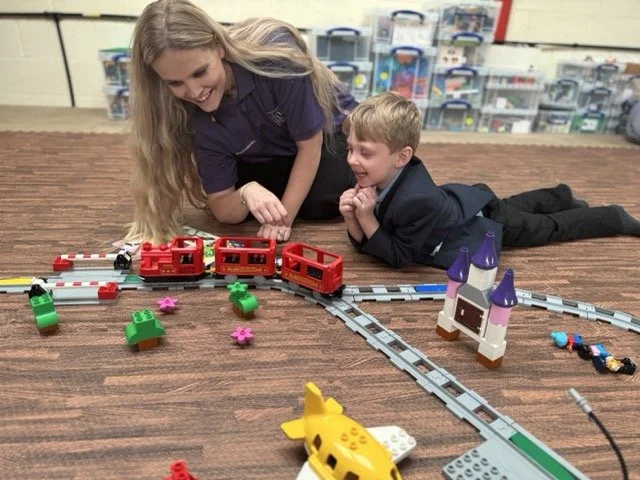
Early Engineers Express is a hands-on STEM workshop using LEGO Duplo trains to build early problem-solving, creativity, and engineering skills through playful exploration.
Early Engineers Express STEM Workshop Description:
Please note, this is a new workshop. We’re running pilot sessions in January with a view to taking first bookings from February half-term 2026 onwards.
The Early Engineers Express STEM workshop challenges children in Nursery, Reception and KS1 to problem-solve a range of rail-themed challenges, with extensions linked to commonly-taught stories. The workshop has been designed by Phillipa Hyett NPQH, an outstanding primary education practitioner, and has been developed to meet objectives across the Early Years Areas of Learning and KS1 curriculum.
Using Duplo trains and tracks, students will be assigned a task to design a railway that will navigate along a route, and be programmed using colour-coded action blocks to stop at checkpoints. Tasks will be coordinated so that every child actively contributes to the train’s route and the overall map.
As part of the core challenge children will design and build the following structures:
train track using a template guide map
trainstation for passengers
bridge that makes a river crossing by rail
level crossing
airport
Extension Activities:
All workshop extension activities start with a story that sets the scene for upcoming challenges. Our current variants are based on the following texts:
‘The Train Ride’ by June Crebbin
‘Lost and Found’ by Oliver Jeffers.
Lost and Found Workshop Variant:
After reading and discussing the text, students have to build an extension to their train track route that gets the lost penguin to a dock so it can go home. As part of the challenge, students will be introduced to docks and harbours which builds on their ‘Understanding of the World’.
The extension requires students to build a harbour/dock and a train route extension with programmed stops.
The Train Ride Workshop Variant:
After reading and discussing the text, children are tasked to build structures from the scenes seen through the windows of the train in the text. This might include a lighthouse to represent the seaside, or a farm, or a castle to represent the countryside etc. The session ends with a poem ‘From a Railway Carriage’ by RL Stevenson.
At the end of all sessions students will have each contributed to a fully-working train track and scene, with programmable stops (such as fueling, or stopping at the train station).
The workshop has been primarily designed around EYFS areas of learning but is suitable for children in year 1 and year 2 as well.
Areas of Learning / Early Learning Goals Coverage
Communication and Language (C&L)
• Listening, Attention & Understanding • Speaking
• Listening to and discussing stories (The Train Ride, Lost and Found) • Following multi-step instructions during building tasks • Using and developing STEM-related vocabulary • Explaining ideas, routes and designs to peers
Literacy
• Comprehension • Writing (Follow-up resources)
• Understanding texts by building related settings and scenes • Sequencing events through train routes and story-inspired builds • Retelling stories through construction • Optional writing opportunities: labelling stations, routes, maps
Understanding the World (UtW)
• People, Culture and Communities • The Natural World • (Light link) Past and Present
• Exploring how things work (action bricks, cause-and-effect) • Understanding human-made structures: bridges, stations, airports, docks, lighthouses • Learning about environments in stories (coast, countryside, harbours) • Designing maps and understanding basic geography
Mathematical Development
• Numerical Patterns • Shape, Space and Measures
• Spatial reasoning through track layout design • Sequencing and logic through colour-coded programming bricks • Comparing lengths, heights, and shapes of structures • Problem-solving using trial and improvement
Personal, Social and Emotional Development (PSED)
• Self-Regulation • Building Relationships
• Teamwork when creating a shared railway system • Turn-taking, negotiation and role-sharing • Building resilience when structures need adapting • Developing confidence when presenting ideas
Physical Development (PD)
• Fine Motor Skills
• Manipulating Duplo bricks, track pieces and small components • Coordinating movements when assembling detailed structures • Moving around a large collaborative map
Expressive Arts and Design (EAD)
• Creating with Materials • Being Imaginative and Expressive
• Designing scenes inspired by stories • Constructing models representing real-world locations • Using imagination to expand the story through building (e.g., farms, lighthouses, castles)