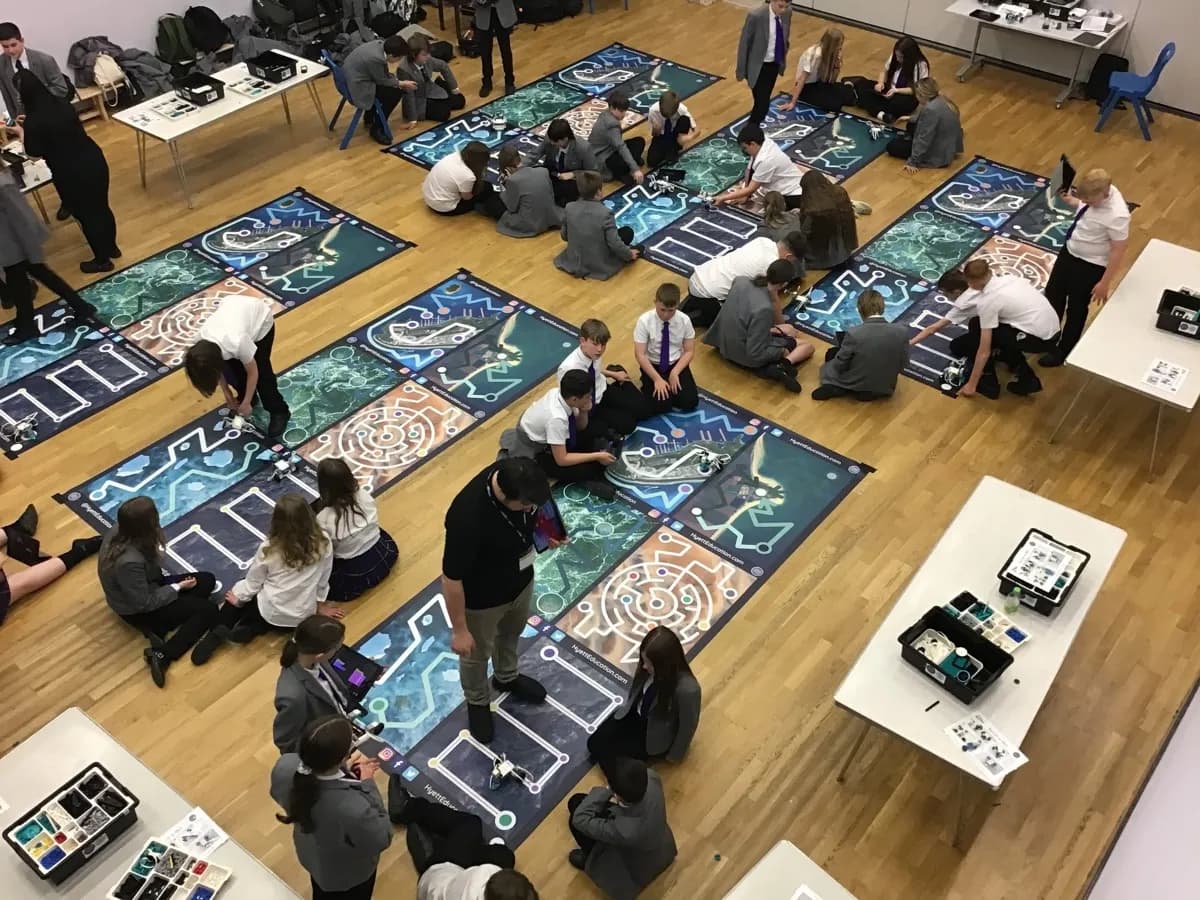


Over the summer, we ran two intensive holiday clubs on behalf of the DNE EKO programme — one in Plymouth at Stoke Damerel College (July 28 to August 8) and another in Barrow-in-Furness at Victoria Academy (August 18–29). Between them, 134 children aged 8 to 14 got stuck into a fortnight of proper STEM activities. Not colouring sheets and word searches. Real kit, real skills.
What the Children Actually Did
We packed a lot in. Each day had a different focus, and the children rotated through activities including:
- Building and programming robots
- Coding autonomous drones
- 3D design using TinkerCad, with prints they could take home
- AI and machine learning fundamentals
- Cybersecurity and cryptography challenges
- Electricity and circuits
- Science experiments, including building and launching rockets
- Stop-motion animation
- Creating 3D models with doodler pens
The variety matters. Some children arrived certain they didn’t like “techy stuff” and left having found something that clicked. That’s exactly the point of a programme like this.

What Parents Said
Parent feedback is always the honest measure. We heard things like: children who typically resist holiday clubs were actively excited to attend. Several parents told us their children had started talking about careers in science and engineering for the first time. One parent mentioned their daughter now wants to be a scientist. That kind of shift doesn’t happen from watching a demonstration — it happens when children get to do things themselves.
Why Funded Programmes Matter
Both of these clubs were fully funded through our defence STEM partnerships. The families paid nothing. That’s not a small thing. In communities where the nearest science centre is an hour’s drive away and specialist equipment isn’t in the school budget, access to this kind of provision can be genuinely transformative.
We brought all the equipment — robots, drones, 3D printers, micro:bits, laptops, the lot. Schools and community venues provided the space. It’s a model that works, and we’re looking to expand it further. The important thing is that children in Plymouth and Barrow-in-Furness got exactly the same quality of STEM experience that children in any well-resourced school would receive. Geography shouldn’t determine whether a child gets to program a robot.
What’s Next
If your school or community organisation is interested in hosting funded STEM workshops, whether during term time or holidays, we’d love to hear from you. These programmes exist because there’s real demand for hands-on STEM in areas that don’t always get it. Let’s change that.
Frequently Asked Questions
What are EKO funded STEM holiday clubs?
EKO (Engagement, Knowledge, and Opportunities) is a funded programme that provides free STEM holiday activities for young people in specific communities. Hyett Education delivered robotics, coding, circuits, and engineering workshops to 134 young people across the summer programme.
What activities do children do at STEM holiday clubs?
Children participate in hands-on activities including building and programming robots, coding challenges, constructing electrical circuits, and engineering design projects. All equipment is provided and sessions are led by DBS-checked STEM instructors.
How can schools access funded STEM programmes?
Funded programmes are available through partnerships including the RAF, Defence Nuclear Enterprise, and local community organisations like EKO. Contact Hyett Education to find out if your school or community qualifies for fully funded STEM workshops.