


Drones in Education: Beyond the Novelty
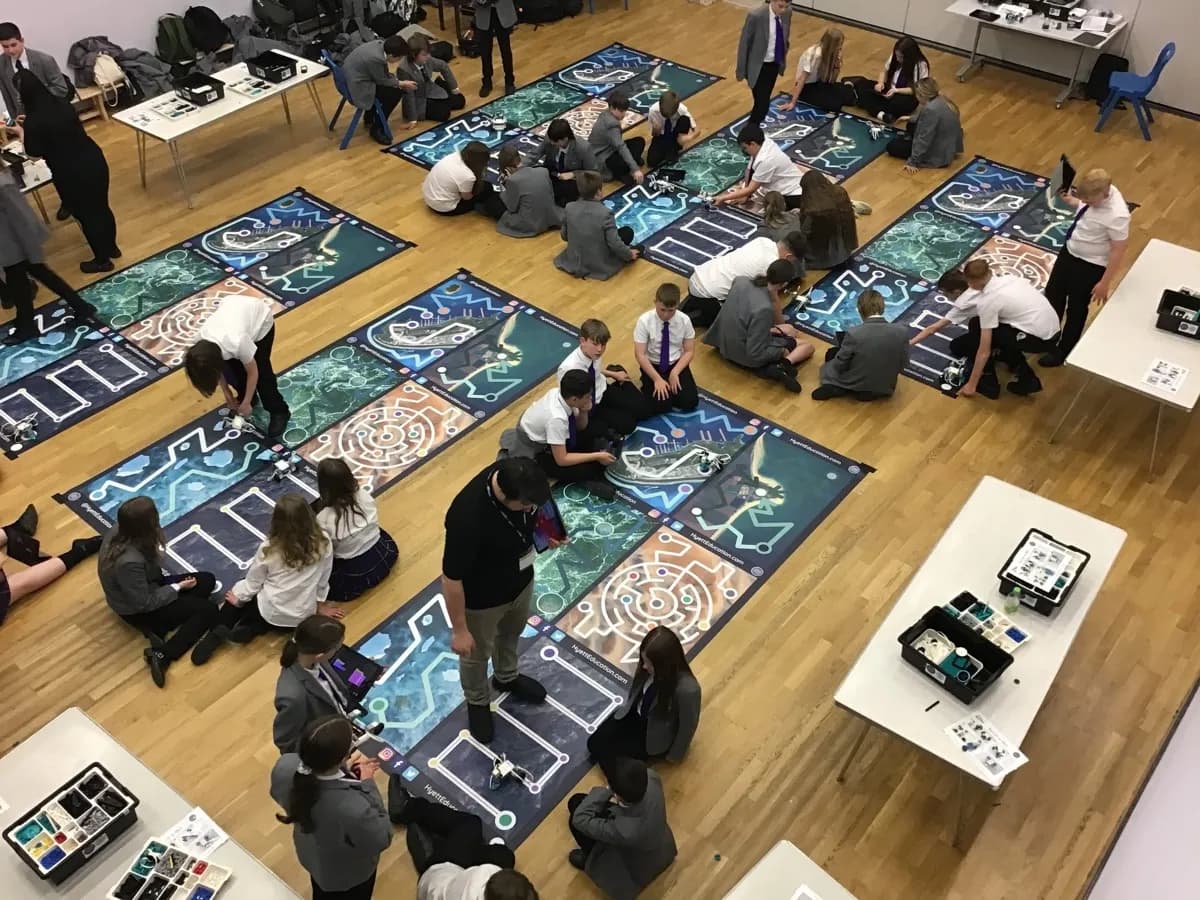
A well-run drone session teaches far more than how to fly. Pupils learn computational thinking, an understanding of forces, and problem-solving through trial and error. Because the code produces a physical, visible result, mistakes are obvious. When a drone flies into a net because the sequence was wrong, debugging stops being abstract and becomes something pupils can see and correct.
That is the difference between a gimmick and a lesson. The spectacle gets pupils engaged; the structured activity turns that engagement into learning that connects to the classroom. Coding a drone reinforces the same principles that underpin the wider primary computing curriculum, just with a more memorable output.

How Drone Workshops Map to the National Curriculum
Drones link directly to at least three National Curriculum subjects: computing, science and geography. That cross-curricular reach is what separates a purposeful drone workshop from a one-off treat.
Computing: Programming Physical Systems
The Key Stage 2 computing programme of study asks pupils to "design, write and debug programs that accomplish specific goals, including controlling or simulating physical systems". A drone is precisely that kind of physical system. Pupils sequence flight commands, use loops to repeat manoeuvres, and debug when the drone does not fly where they expected. Depending on age, they work in block-based coding, Python or Swift.
Science: The Forces of Flight
A drone stays in the air through the interplay of thrust, lift, weight and drag. That makes it a live demonstration for the Year 5 science unit on forces, where pupils are taught to "identify the effects of air resistance, water resistance and friction that act between moving surfaces" and to explain why unsupported objects fall towards the Earth. Add weight to a drone and pupils see the effect on lift straight away.
Geography: A View From Above
Drones give pupils a genuine aerial perspective. The Key Stage 1 geography curriculum expects pupils to "use aerial photographs and plan perspectives to recognise landmarks and basic human and physical features". Older pupils can extend this into mapping, scale and how surveyors capture data from the air, connecting the workshop to cross-curricular STEM learning that runs beyond a single subject.
Are Drones Safe to Use Indoors?
Yes. Educational drone workshops fly indoors, where flights sit outside Civil Aviation Authority airspace rules and no operator registration is required. A flight only counts as indoor when the drone cannot escape into outside airspace, which is why a school hall or sports hall with a defined, netted flight zone is the standard setup.
Providers use lightweight, prop-guarded drones designed for classroom use, not outdoor surveying equipment. Every person in the room wears protective eyewear, and risk assessments are supplied in advance. Hyett Education's drone coding workshop runs from Year 5 to Year 13 (ages 9 to 18), with sessions built around the age and experience of the pupils in front of the facilitator.

From the Classroom to Real Careers
Drones are a growing UK industry, not a passing trend. The UK commercial drone market generated around 980 million US dollars in revenue in 2024 and is forecast to keep growing through 2030, according to Grand View Research. Agriculture, surveying, construction, filmmaking and the emergency services all now depend on them.
The public sector is one example. The National Police Chiefs’ Council says UK police forces carry out around 60,000 drone flights a year. A separate £230 million government package announced in 2024 covered a wider range of police technology, including drones, facial recognition, automation and other tools; it was not a drone-only allocation. These uses give pupils a concrete careers context without overstating the spending commitment.
Why Schools Book Workshops Rather Than Buy Drones
A fleet of education-grade drones, plus spares, charging, insurance and staff training, runs into thousands of pounds for equipment used a handful of times a year. Someone also has to learn to fly them safely and program them, which is a real ask for teachers already stretched across the curriculum.
Booking a workshop brings the drones, the specialist facilitator and the risk assessments to you, with no capital outlay and nothing to store afterwards. Hyett Education's drone workshops start from £597 per day, with the final figure depending on equipment and travel rather than pupil numbers. You can request a tailored quote to see how that works for your school, and eligible schools can access fully funded STEM workshops through our Royal Air Force and Defence partnerships.
Frequently Asked Questions
What age can children start using drones in school?
Educational drone flying usually starts from Year 5, around age 9. Hyett Education runs drone workshops for Years 5 to 13, adjusting the coding platform and challenge level so that a Year 5 class and a Key Stage 5 group each work at the right level.
Do schools need a licence to fly drones indoors?
No. Indoor flights are not part of regulated UK airspace, so no CAA operator registration is required for a session held in a school hall. Providers still carry out full risk assessments and use netted flight zones and protective eyewear as standard.
What subjects does a drone workshop cover?
A drone workshop maps to computing, science and geography. Pupils program flight paths (computing), explore the forces that keep a drone airborne (science), and consider aerial mapping and real-world uses (geography), all within one session.
How much does a drone workshop cost?
Hyett Education's drone workshops start from £597 per day, with pricing based on equipment and distance rather than the number of pupils. For a figure tailored to your school, use the instant quote tool, and check whether your school qualifies for funded provision.
Bringing Drones to Your School
Drones earn their place in a school when they are treated as a curriculum tool, not a spectacle. Programmed well, they let pupils write code that flies, watch forces act in real time, and see where a STEM skill leads in the working world. If you want to bring that into your classrooms, book a drone workshop or talk to our team about fitting it around your computing and science planning.