
Years 5 to 13
Drone Coding Workshop
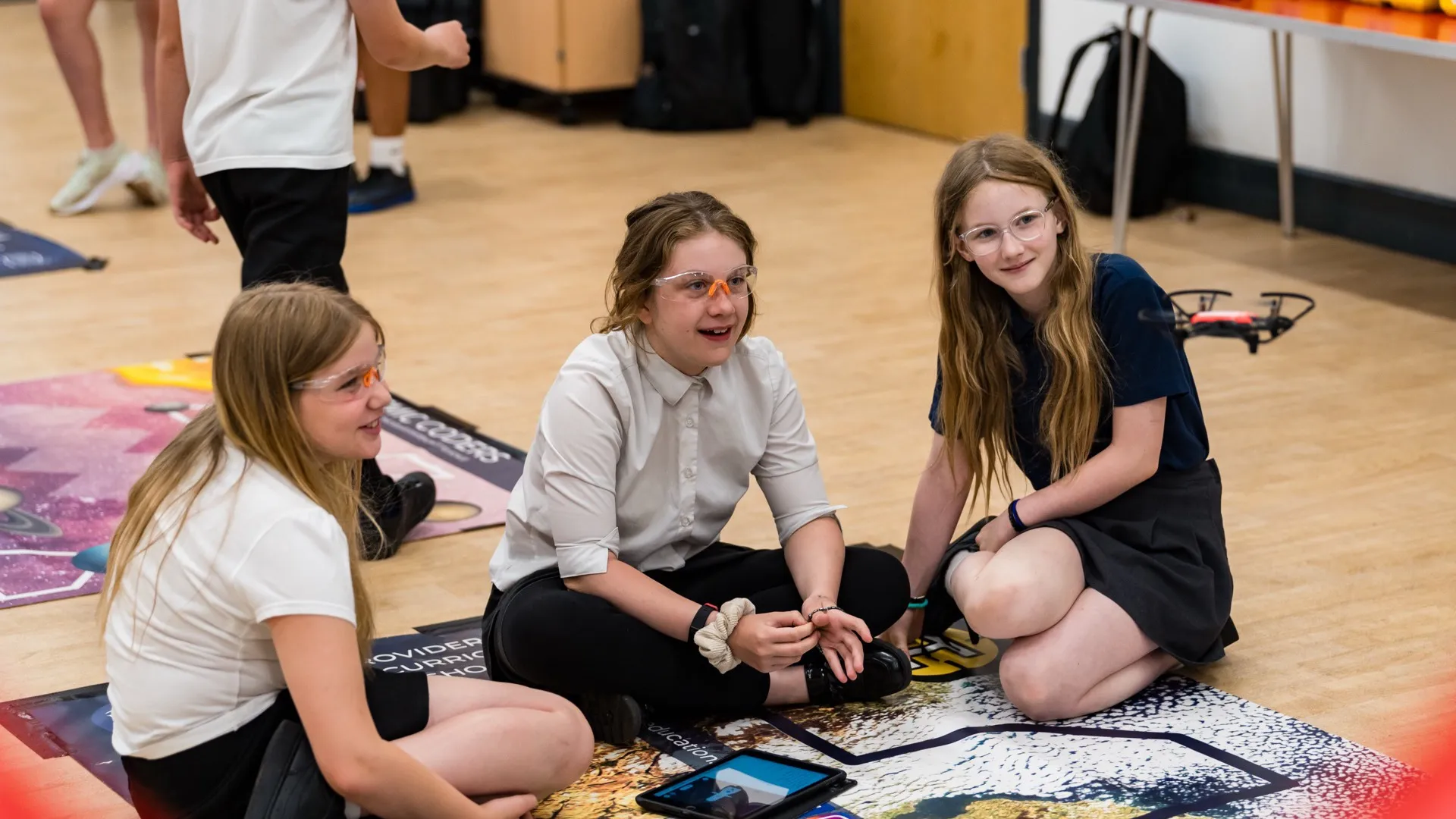
Code flight paths and explore aerospace engineering through hands-on drone programming. Up to 30 students per session, with safety eyewear provided for everyone.
From £697 per day, excluding VATSee your exact price
 RAF STEM Education PartnerNamed on the RAF STEM Services Framework, 2023 to 2028
Workshop Formats
Choose Your Format
Choose the format that suits your school timetable. All formats include full setup and packdown by our team.
| Format | Sessions a day | Session length | Pupils per session | Pupils per day |
|---|---|---|---|---|
| In-Depth ExperienceDeeper exploration with advanced drone technology | 2 | 2 hours | 30 | 60 |
| Standard ExperienceChallenge maps and obstacle course hoops includedTypical day shown below | 3 | 90 minutes | 30 | 90 |
| Taster ExperienceShort introductions with challenge map routes | 4 | 60 minutes | 30 | 120 |
| Express ExperienceMaximum reach across the school | 5 | 45 minutes | 30 | 150 |
Note: Up to 30 pupils per session and up to 150 pupils across the five-session Express format. A large indoor space with high ceilings is required.
Session Structure
Typical Workshop Day
Based on the Standard Experience format: 3 sessions of 90 minutes each. Exact times and breaks are agreed with the school.
| Stage | Activity |
|---|---|
| Before Session 1 | Hyett Education arrives and sets up the specialist workshop equipment in the space prepared by the school |
| Session 1 (90 minutes) | Class group 1 (up to 30 pupils) |
| Between Sessions 1 and 2 | Changeover or break, as agreed with the school |
| Session 2 (90 minutes) | Class group 2 (up to 30 pupils) |
| Between Sessions 2 and 3 | Changeover or break, as agreed with the school |
| Session 3 (90 minutes) | Class group 3 (up to 30 pupils) |
| After Session 3 | Hyett Education packs down its workshop equipment; the school retains its normal site and pupil-supervision duties |
What pupils learn
Learning outcomes
- Program autonomous drone flight paths
- Understand the principles of flight and aerodynamics
- Apply coding concepts to physical computing
- Learn about real-world drone applications
- Follow safety protocols and regulations
- Work in teams to complete flight challenges
Curriculum links
These are relevant curriculum areas. Exact links depend on the cohort, delivery jurisdiction and booked format.
- ComputingProgramming, algorithms, sequence and repetition
- PhysicsForces, flight, aerodynamics
- GeographyMapping, surveying, real-world applications
Careers Framework
Gatsby Benchmark Alignment
This workshop can contribute to the following Gatsby Benchmarks within a school's wider careers programme.
Learning from Career and Labour Market Information
Highlights career pathways in aerospace, drone technology, and unmanned systems, fast-growing sectors with strong demand for skilled operators and engineers.
Linking Curriculum Learning to Careers
Connects computing, physics, and mathematics curriculum to real-world applications in aerospace engineering and drone technology.
Encounters with Employers and Employees
Applies only when an employer or employee joins a two-way encounter with pupils and the activity includes reflection. Partner branding or a themed workshop alone does not qualify.
The Gatsby Benchmarks are the national framework for good careers guidance and are referenced in statutory guidance for schools in England.
In the Classroom
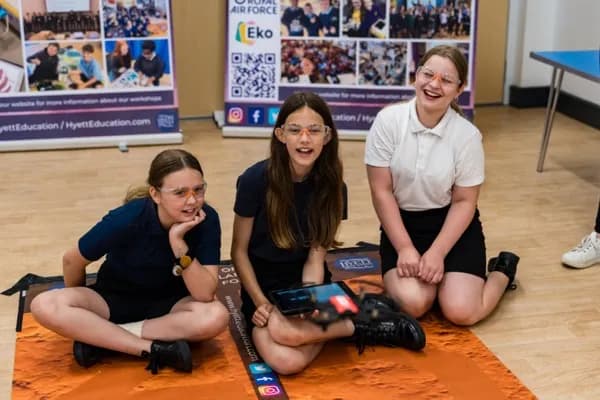
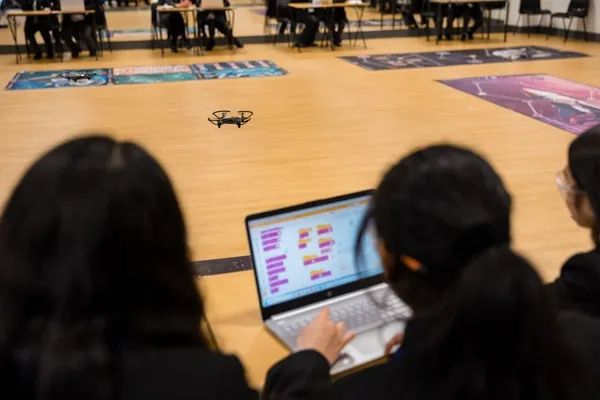
Workshop in Action
Inclusion and safety
Built for every learner, ready for your checks
Every learner can take part
Our instructors have extensive experience working across different school environments, including mainstream, SEND, SEMH, alternative provision, pupil referral units, and special schools.
Our SEND support approach (opens in a new tab)Risk assessment supplied
In-school delivery avoids off-site transport and its travel risk assessment. Hyett Education supplies the activity risk assessment, while the school retains its normal on-site duties and decides how its usual consent and family-information procedures apply.
Download the risk assessment (PDF)Enhanced DBS, continuously monitored
Every Hyett Education instructor holds an enhanced DBS certificate and is registered on the DBS Update Service. Your instructor's DBS details are shared in your secure booking portal once your booking is made.
Stretch and challenge
Schools can share the cohort profile in advance so the instructor can discuss suitable challenge, grouping and adjustments for the booked format.
Our teaching approach (opens in a new tab)
Read the full SEND and stretch notes
Our instructors have extensive experience working across different school environments, including mainstream, SEND, SEMH, alternative provision, pupil referral units, and special schools. Every activity is scaffolded and differentiated so that all learners can access the content, experience success, and develop confidence. We use adaptive teaching strategies, manage cognitive load carefully, and provide visual supports and learning mats. Schools can share specific needs in advance so we can plan accordingly. Drone coding provides a highly engaging, visual form of programming where students see immediate physical results from their code. This is particularly motivating for students who find screen-based activities challenging. Activities are scaffolded with progressive challenge maps.
Group sizes: Up to 30 pupils per session and up to 150 pupils across the five-session Express format. A large indoor space with high ceilings is required.
Workshop data identifies extension activities where they are available. Schools can share the cohort profile in advance so the instructor can discuss suitable challenge, grouping and adjustments for the booked format.
- Tiered challenges allow students to progress at their own pace, from guided tasks to independent problem-solving
- Higher-order thinking through debugging, optimisation, and creative design challenges
- Competition pathways: workshops build skills relevant to FIRST LEGO League, Raspberry Pi competitions, Cyber Discovery, and CREST Awards
- Career connections: students discover how workshop skills translate into real engineering, computing, and science careers
Schools can share information about gifted and talented cohorts in advance so our instructors can prepare targeted extension activities.
School Reviews
What Schools Say
Feedback from the teachers and staff was very positive. The children enjoyed their sessions and were all fully engaged in what they were doing.
Drone Coding Workshop
The ease of simplicity of the new app, and the added features of gesture control were a real plus. Personally the ability to swap between block coding and python and for it to be able to map between them were brilliant, as it's exactly the kind of thing we want to be able to leverage to jump pupils from block coding to text based coding. The pupils were super engaged throughout and the feedback has only been positive. Richard and Pete were hyper organised, and ran the day expertly. Really easy to organise, really well run, really engaging!

Drone Coding Workshop
Amazing. Every child of all abilities thrived and had great fun. The collaboration between them all was amazing to see. Lots of children now want drone for Christmas. Richard was organised, flexible when working around timetables and a clear and strong session lead. Highly recommend to all schools.
Drone Coding Workshop
Richard was knowledgeable and enthusiastic The girls loved the hands on opportunities Booking portal was useful Workshop leader available and informative to organise logistics before the event

Drone Coding Workshop
Thank you for conducting the drone activity workshop for our students. The session was very engaging, informative, and enjoyable for the students. They had a great opportunity to learn about drones through practical, hands-on activities, which made the experience both educational and exciting. The instructor was very knowledgeable, supportive, and interacted well with the students. The workshop encouraged curiosity, teamwork, and an interest in technology and innovation. We really appreciate the effort and professionalism of your team in making the session a memorable experience for our students. We look forward to working with you again in the future.

Drone Coding Workshop
Students thoroughly enjoyed the workshop. The workshop facilitator was incredible in supporting the students and engaging them. The activity was also amazing for students to utilise programming skills they learn in class.
Drone Coding Workshop
Related Workshops
You Might Also Like
Early Engineers Express
A play-based EYFS and KS1 engineering workshop using LEGO Duplo trains. Children design, build, and test train tracks, bridges, and stations through hands-on construction challenges.
View workshopBeginner STEMbotics: Robotics & Coding
Inclusive robotics and coding workshop for KS1 and KS2 using LEGO Spike Essentials and LEGO WeDo 2.0. Children code with icon blocks or word blocks, and no reading ability is required.
View workshopIntermediate STEMbotics: Robotics & Coding
Intermediate robotics workshop for KS2 to KS3. Block-based programming with LEGO Spike Prime and EV3, advanced robot builds, sensors, and challenge mats.
View workshop