

If you work in education technology, you already know that 2026 is shaping up to be the year AI properly lands in classrooms. Not as a novelty or a talking point, but as something teachers and students genuinely use. That shift is exactly what drew us to BETT this year at ExCeL London (January 21–23), and it’s driving everything we’re doing at Hyett Education right now.
Why Continuous Professional Development Matters More Than Ever
We’ve always believed that if you’re going to deliver workshops in schools, you’d better be learning just as fast as the children are. BETT gives us the chance to see what’s coming next, speak to other practitioners, and stress-test our own thinking. It’s not a marketing exercise for us — it’s genuine CPD.
This year, the conversations around AI in education have matured considerably. We’re past the “should we use it?” stage and into “how do we use it well?” That’s a much better question, and one we’ve been grappling with in our own AI and Robotics workshops.

What We’re Bringing to the Table
Our leadership team will be at stand NM82, running hands-on demonstrations across four areas:
- Artificial Intelligence — practical AI activities that work within a single lesson, not just theoretical overviews
- Cybersecurity — cryptography challenges that get students thinking like both attackers and defenders
- Electronics — physical computing with real components, not just simulations
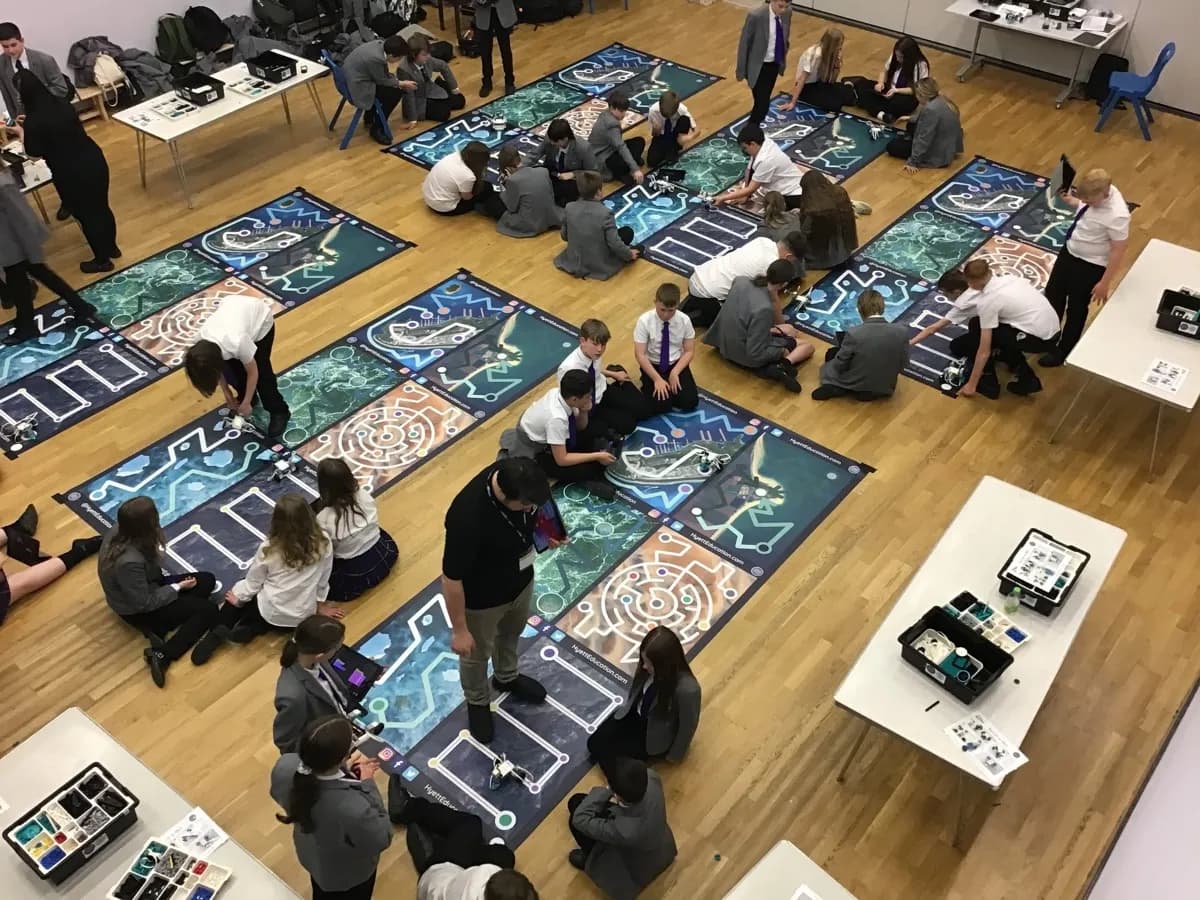
- Robotics — programmable robots that respond to student code in real time
The common thread? Everything is hands-on. We’ve seen too many “STEM experiences” that amount to watching a video and filling in a worksheet. That’s not what we do.
Funded Workshops Through Framework and Programme Work
At BETT, we discussed our RAF framework supply and Defence Nuclear Enterprise regional delivery work. Hyett Education is a supplier on the Ministry of Defence RAF STEM Services Framework (31 Mar 2023–31 Mar 2028). We were awarded DNE regional delivery lots 1 and 2 in September 2023 and have delivered as a regional delivery partner. Through past programme allocations, we delivered fully funded workshops to eligible schools. That historical delivery does not establish that a route is currently open; current availability must be confirmed at the time of enquiry.
Looking Ahead
The pace of change in technology means the computing curriculum needs practitioners who actually keep up. That’s our commitment: to stay at the front of what’s possible and bring it back to schools in a way that’s accessible, practical, and properly educational. Not flashy for the sake of it, but genuinely useful.
If you’re at BETT, come and find us. We’d rather have a proper conversation than hand you a leaflet.
Frequently Asked Questions
What is the future of STEM education in UK schools?
Current themes include wider discussion of AI literacy, sustainability, interdisciplinary problem-solving and school-industry links. England’s revised curriculum is not yet final: publication is planned for spring 2027 and first teaching for September 2028, so anticipated content should not be presented as a current statutory expectation.
Why does CPD matter for STEM teachers?
Technology evolves rapidly, and teachers need ongoing support to keep their subject knowledge current. Effective CPD builds confidence with new tools and pedagogies, ensuring students receive up-to-date, engaging STEM education rather than outdated content delivered without conviction.
How are funded partnerships changing STEM access?
Employer- and programme-funded workshops can reduce cost barriers when a current round is open and a school is allocated a place. Hyett Education’s RAF-coded and DNE EKO-coded records describe past delivery; they do not establish current availability. Confirm the live round, eligibility and allocation at the time of enquiry.